


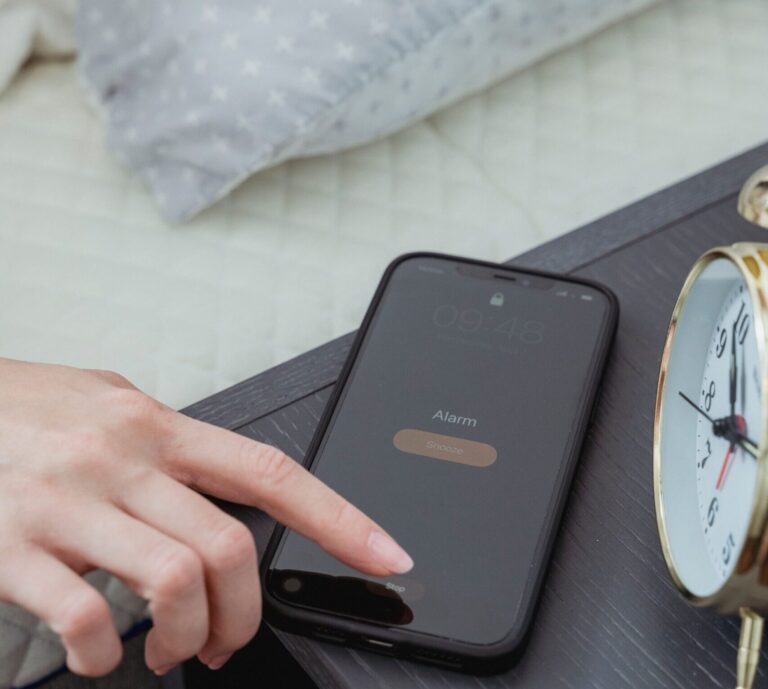
Step away from the flat white – these are the real tricks for resetting your body clock.
Getting up early is hard work. And if you’re not naturally a morning person, it can feel like pure torture.
Let me say this up front: being a night owl doesn’t make you lazy. Some of us simply aren’t wired to be at our best first thing. I’ll confess I need at least one coffee just to get out the door – and another before I can drive to work.
So what makes someone an early bird (often called a ‘lark’) rather than a night owl? And can a true night person ever become a bright-eyed, up-and-at-’em type? It’s worth knowing in a world built around early starts. If you have to be up early for school, the kids or work, you may need to shift your body clock forward.
Sleep medicine specialist Dr M. Taruj Ali and Brian Gunia, PhD, a business professor whose research busted a major myth about night owls – here’s what they had to say.
Why are some people morning people, while others are night owls?
Each of us has a chronotype – a fancy term for your body’s natural preference for when to sleep and when to wake, explains Dr Ali. Your chronotype reflects your circadian rhythm, the roughly 24-hour internal clock that governs your sleep–wake cycle, as well as your body temperature and digestion.
In short, your genes and your body clock decide whether you hit your stride early or later in the day. “Being a night owl is mostly determined by biology,” Dr Ali says. “Our brain has a master clock in the suprachiasmatic nucleus (SCN), which is a tiny cluster of cells in the hypothalamus that controls the daily rhythm of sleep and wake cycles.”
This internal clock gives you a daily rhythm that’s uniquely yours. “People’s energy naturally ebbs and flows in reliable 24-hour cycles, or circadian processes,” Gunia says. Some people are sharpest and most energetic in the morning, then flag as the day wears on. (Hello, 4pm slump!) Others feel sluggish in the morning but gradually build energy and focus, peaking in the evening.
While plenty of us lean clearly towards mornings or evenings, some people could go either way.
Can you change your natural tendency to be a night owl?
We won’t sugar-coat it: yes, but it isn’t easy. Because your chronotype is partly genetic and largely controlled by your brain, there are a few hurdles to clear. “People can, and do, change their chronotype somewhat,” Gunia says – though he suggests only trying if you have a concrete reason. Perhaps you need to be up early to look after a child, or a new job means starting earlier.
Bear in mind you’re most likely to succeed if you stick to your new routine strictly. In other words, no playing by the rules Monday to Friday, then partying half the night and sleeping until midday at the weekend. (Sorry!)
So how do you become a morning person? You need to reset your body’s circadian clock. How on earth do you do that? We’re so glad you asked. With a few simple strategies and a little patience, you can learn to seize the day.
1. Get early light
The most powerful tool for shifting your chronotype is light. “Light that hits the retina is the strongest signal that resets the circadian clock,” Dr Ali says. Morning light in particular moves your body clock forward – and according to occupational health research, it’s most effective within an hour of waking.
Your best bet is to get outside and soak up some natural daylight first thing. If you can’t manage that within an hour of getting up, there’s a workaround: sitting near a full-spectrum ‘light box’ can also do the job, Dr Ali says. The light from these devices reaches your retina and prompts your SCN to bring your body clock forward. Look for a light-therapy lamp rated at 10,000 lux and sit near it for 10 to 15 minutes after waking – you could enjoy your morning coffee in its energising glow. They’re widely available online, and some even double as alarm clocks.
2. Consider a low dose of melatonin
Melatonin is a hormone your brain makes naturally to signal when it’s time to nod off and when to wake. A synthetic version can help you fall asleep at the time you choose. To bring your bedtime (and your body clock) forward, Dr Ali suggests taking melatonin two hours before you plan to go to bed. Keep the dose small – he recommends 1 to 3 milligrams – so it doesn’t backfire and throw your system out of whack.
In Australia and New Zealand, melatonin is regulated as a medicine. In Australia, most melatonin needs a prescription from your GP, although adults aged 55 and over with insomnia can buy a low-dose, slow-release version from a pharmacist for short-term use. In New Zealand, the rules have recently been relaxed and some melatonin products can now be bought from pharmacies. Either way, have a chat with your doctor or pharmacist before you try it.
3. Ban blue light at night
Any bright light in the evening pushes your body clock later, making it harder to drift off at your chosen bedtime and to feel human in the morning. So dim the overhead lights and put your devices away for at least an hour or two before bed.
Why? Your circadian clock is most sensitive to light at night, when the sun has gone down – especially blue light, or full-spectrum light, which contains blue. Even a lamp can disrupt your rhythm and nudge you further towards night-owl territory, so keep things as dim as you can bear, particularly as bedtime approaches.
As a rule, switch off screens an hour before bed. If you really must read on a device or fire off a quick email, wear blue-light-blocking glasses or turn on your phone’s blue-light filter. (And yes, they really do make a difference!)
4. Work out – but not too close to bedtime
Regular exercise is key to sleeping well and being able to get moving in the morning. A 2023 review of studies published in the journal Cureus found that consistent, moderate exercise may improve sleep quality and make it easier to fall asleep at night. The researchers put this down to exercise helping to regulate circadian rhythms and triggering the release of stress-busting endorphins, along with calming brain chemicals such as serotonin.
One word of warning: avoid tough workouts – a HIIT class or a run, say – in the evening, as they can make it harder to drop off, according to the same review. That’s probably because intense exercise late in the day pushes your body clock back, delaying the release of sleep-inducing melatonin.
5. Set an earlier bedtime and wake-up time – and stick to them
Going to bed and getting up at the same times every day will lock in your new early-bird routine. The switch to becoming a lark may be a little bumpy at first, and that’s perfectly fine. If you have the odd late night, don’t stress – just keep getting up on time every day. (We know it’s tough!) So what should you do if you fall off the wagon?
First, don’t be hard on yourself – it happens. A few late nights out, a lie-in, or jet lag that has you wide awake at 2am. Dr Ali’s advice is to focus on waking up on time first, and not worry about your bedtime just yet. Set that early alarm and get up (or drag yourself out of bed) at your target time.
Then, after a few days of early starts, gradually bring your bedtime forward by 30 minutes at a time over several days. For example, the first night you’d move it from midnight to 11.30pm, the next night aim for 11pm, and so on. Before you know it, you’ll be back on track.
Is it really better to be a morning person than a night owl?
The truth is, there’s no ‘best’ chronotype – each has its pros and cons. Morning people, for example, have better working memories, according to a 2021 study published in Sleep Advances. On the other hand, “some studies suggest that evening people have slightly greater cognitive ability,” Gunia says. But early birds may have the edge in everyday life, he notes, since night owls often end up sitting exams or giving work presentations at 9am, when they’re not at their best.
When it comes to health, larks seem to come out ahead. Night owls face a higher risk of type 2 diabetes, obesity, high cholesterol and heart disease. But Dr Ali points out that “most of it is because of the mismatch between night owls’ internal clock biology and the morning-oriented world.” Research suggests these risks are largely down to lifestyle habits that are more common among night owls, such as a poor diet (often eaten late), drinking more alcohol and keeping irregular sleep hours.
The real catch with trying to flip your chronotype is that it rarely works completely – night owls still tend to feel a bit groggy in the morning, says Gunia. So rather than fighting your biology, he suggests it may make more sense to plan your day around your natural rhythm. Gunia himself is a morning person and tackles his most demanding tasks, such as writing, first thing. It’s a smart approach: a 2021 study in Nature Communications found larks performed better at learning and attention tasks in the morning, while night owls did better in the evening.
Strangely enough, your chronotype may also influence when you’re at your most ethical, according to research co-authored by Gunia and published in Psychological Science. The study found we behave more ethically when we’re at our most alert. Earlier research had suggested most people are more ethical in the morning – dubbed ‘the morning morality effect’ – but Gunia and his colleagues found this only holds true for morning people. “Evening people seem to be most ethical in the evening,” he says. “This suggests that people may want to make ethical decisions whenever in the day they feel most alert.”
Find out how to stop sabotaging your sleep