

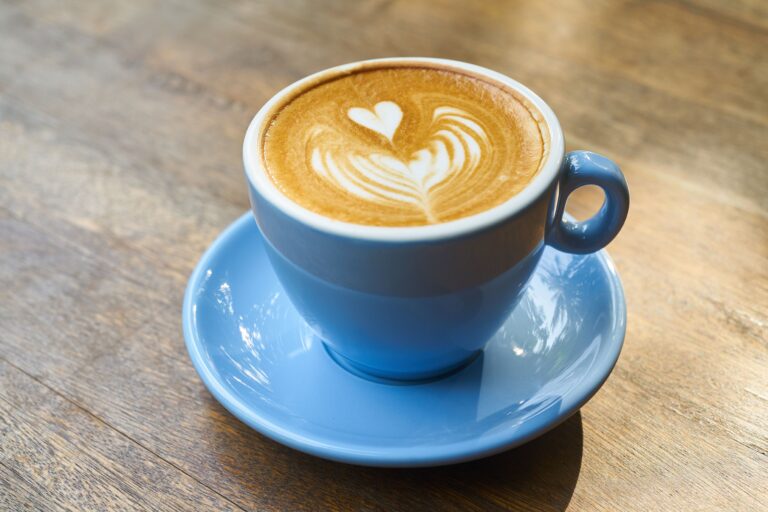
Quick question. What’s your go-to coffee shop?
Now the harder question: why is it your go-to?
Be honest. Is it really the coffee, or is it that the barista behind the counter remembers you take one sugar? That the corner table gets the morning sun? That it’s exactly 200 steps from your front door, and they’ve started your flat white before you’ve finished saying good morning?
Most of us couldn’t tell you where our favourite café’s beans come from. We just know that this cup makes the morning work. But behind it is a world of accidents, arguments, court cases and even one very determined Invercargill grocer. Here’s what we found.
- Australia’s biggest coffee seller isn’t a café at all
McDonald’s sells roughly one in every four coffees bought in Australia. McCafé pours about 630,000 cups a day, which comes to around 230 million a year across more than 1,000 locations.
Behind it, in second place, sits 7-Eleven at roughly 80 million cups a year from its 763 stores.
Together, a burger chain and a petrol station outsell every dedicated coffee chain in the country combined.
2. And McCafé is an Australian invention
Here’s the part that should make you a little proud. McCafé was dreamed up in Melbourne in 1993, conceived by McDonald’s Australian team rather than imported from head office.
It worked so well that it was exported back to America in 2001 and to Britain in 2003. There are now McCafés in more than 60 countries, and the whole thing started on Swanston Street.
3. We have far more cafés than you’d guess
The remarkable bit isn’t the number, it’s the ownership. IBISWorld puts it flatly: “The industry has no major players. Industry businesses are often owner-operators that have one establishment.”
The figures bear that out. The biggest company in the entire Australian café industry is Retail Food Group, owner of Gloria Jean’s, and it holds just 1.3% of the market. Everybody else, all 28,000-odd of them, splits the remaining 98.8% between them.
4. That famous Wellington claim? Sort of true
You’ve heard that Wellington has more cafés per capita than New York. Run the numbers today and it roughly holds. Wellington City has about one café, restaurant or takeaway per 229 residents, whereas New York manages about one per 300 to 330. Wellington comes out around 30 to 45% denser.

5. The coffee break was born in a Denver necktie factory
The workplace coffee break has a proper origin story, and it’s better than you’d expect.
Phil Greinetz ran Los Wigwam Weavers in Denver, making neckties and scarves on hand looms. During the Second World War, with young men away fighting, he hired middle-aged women, and he noticed they were going home wrung out, “so tired their cheeks would be sunk in.”
So he introduced two 15-minute rest periods, morning and afternoon. They were optional at first, but once he noticed productivity had jumped he made them compulsory. He just didn’t pay for the half hour.
A labour inspector took him to court, and in July 1956 the US Tenth Circuit Court ruled that the breaks “bear a close relationship to employment” and therefore had to be paid.
Every paid tea break you have ever taken traces back to a necktie factory and a boss who noticed his staff were exhausted.
(The phrase itself came later, from a 1952 advertising campaign: “Give yourself a Coffee-Break.”)
6. A New Zealander invented instant coffee, then waited 120 years for the credit
David Strang arrived at Bluff from Glasgow in 1863, aged sixteen, and by 1872 was running a coffee and spice works in Invercargill. In January 1889 he patented a process that dried a strong coffee infusion in hot air, leaving a soluble powder. It went on sale that July in tins marked “MADE INSTANTLY WITH BOILING WATER.” One survives at Puke Ariki museum in New Plymouth.
For more than a century, the credit went elsewhere, to Satori Kato, a Japanese chemist who demonstrated instant coffee in Buffalo in 1901, twelve years after Strang.
Then a heritage adviser changed the story. While researching an Invercargill house for historic registration, Susan Irvine worked out what Strang had actually done, and when. The house was listed in 2012, the claim went with it, and New Zealand media picked it up. Today Te Ara, New Zealand’s state encyclopedia, credits Strang with inventing instant coffee, and so does Wikipedia.
7. Nescafé exists because of the Great Depression
Instant coffee’s big commercial break came from a financial disaster. After the 1929 Wall Street Crash, coffee prices collapsed and a French-Italian bank found itself sitting on warehouses full of unsold Brazilian beans.
Nestlé chemist Max Morgenthaler spent six years working on the problem, and Nescafé launched on 1 April 1938. The name is simply Nestlé plus café.
Then the Second World War made it a household staple, because the entire output of the American plant was reserved for the military.
8. Who Really Invented the Flat White?
Australia and New Zealand both have strong claims to the flat white. In Australia, Alan Preston put “flat white” on the menu at Sydney’s Moors Espresso Bar in 1985, drawing on coffee traditions he encountered in far north Queensland. In New Zealand, Wellington barista Fraser McInnes is credited with popularising the name in the late 1980s after a cappuccino made with trim milk came out flat.
Adding to the story, the term appears in a 1963 British film, while the Oxford English Dictionary records it from 1971. Whatever its exact origins, the flat white has become a much-loved coffee tradition shared by both sides of the Tasman.
9. Melbourne quietly invented another one, the “magic”
If you’ve never ordered a magic, you’re not alone. This Melbourne-born coffee has only recently started making its way overseas. A magic combines two ristretto shots — espresso stopped early for a shorter, sweeter and less bitter flavour — with steamed milk in a small 120–150ml cup.
The smaller size is key: it contains less milk and a stronger coffee flavour than a flat white, with the milk and foam staying well integrated throughout the drink.
The magic emerged in Melbourne in the 2000s, with St Ali, Cafe Ray’s and Newtown S.C. all linked to its origins. Melbourne lawyer Zenon Misko says he asked Newtown S.C. owner Cate Della Bosca to use less milk in his usual double-ristretto flat white, creating the drink.
Its popularity has since travelled well beyond Melbourne. In 2023, Marks & Spencer introduced magics at 330 cafés across Britain, and by 2025, the drink had also appeared in Indonesian cafés. Not bad for a simple tweak to a regular coffee order.
10. Starbucks lost $105 million learning we’re fussy
Starbucks arrived in Australia in 2000 and grew to around 84 stores, but in 2008 it closed 61 of them, more than 70%, after burning through about US$105 million.
The diagnosis was that it expanded too fast, priced above local cafés, served coffee sweeter than we wanted, and walked into a café culture built over fifty years by Italian and Greek migrants.
The postscript is kinder. Starbucks Australia turned its first-ever profit in 2023, having stopped competing with your local barista and started selling cold, sweet, customisable drinks to a younger crowd.
11. Decaf is not caffeine-free
A University of Florida study found that decaf coffees from major chains contained 8.6 to 13.9 milligrams of caffeine per 16-ounce serve.
Since a regular cup has around 85mg, five or six decafs will give you roughly the same hit as one ordinary coffee, which is worth knowing before the third after-dinner cup.

12. That 3pm coffee is still with you at bedtime
Caffeine’s half-life in a healthy adult averages about five hours, though it ranges from 1.5 to 9.5 hours depending on your genetics.
Smoking speeds it up, while the oral contraceptive pill can double it. That’s why your friend can have an espresso after dinner and sleep like a stone while you’re still staring at the ceiling at 1am. You’re not imagining it.
13. One tree, one year, one fortnight of drinking
An average coffee tree produces about 4.5kg of cherries a year, which yields roughly 900 grams of green beans, and it takes three to four years before a new tree bears fruit at all.
So a full year of one tree’s work gets a regular coffee drinker through about a fortnight.
Most cherries hold two beans, though about 5% produce just one round bean, the “peaberry,” which some roasters prize.
14. Someone paid $46,000 for a kilo of coffee, and a New Zealander held the record before them
This is where coffee stops behaving like a drink and starts behaving like fine wine.
In August 2025, twenty kilograms of Panamanian coffee sold at auction for US$604,080. That works out at US$30,204 per kilogram, or around A$46,000. On the same day, ordinary commodity coffee was trading at about US$6.57 a kilo, which means the winning lot went for roughly four and a half thousand times the price of the coffee in your supermarket.
It was bought by a café in Dubai after 549 separate bids.
Before Dubai, the world record was held by a New Zealander.
In August 2023 the Auckland roaster Coffee Tech paid US$10,005 per kilogram for a Panamanian Geisha, which was the first time any coffee had broken ten thousand dollars a kilo and the highest price ever paid at that point.
So, back to your café
Next time you’re waiting for your order, have a look at the bag behind the counter.
Somewhere on it is a roaster’s name, and quite possibly a farm, a region and an altitude. That coffee has crossed an ocean. It grew on a tree that took four years to fruit, and it was picked, probably by hand, then sorted, dried, shipped, roasted, ground and pulled through a machine descended from a design patented in Turin in 1884.
And it’s in your hand because a barista knows how you like it.
Worth the extra fifty cents, really.